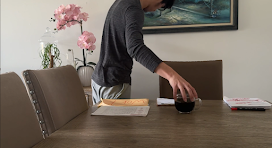
Day Three is upon us, time to use the Filmic Reactions to guide my fine tooth comb to success.
First thing, I cut the phone zoom shot. Automatically make the shock of the sound and flow of the scene better.
Second thing second, I need to lower and adjust audio. Carrion's dialog is really low and adjusting the hum and buzz of my AC is a pain. So what I did was make the non-dialogue bits quite with the dialogue bits loud, the add a cross-fade to blend them together. Alongside that my song "Surprise" has a very loud and obnoxious sound right in the middle of the coffee making scene. It's not too hard to remove, all it needs is some looping and a cross-fade.
The section of audio where I looped the audio
Third thing, I need to rotoscope a bunch of shots. Namely the two major complaints from the feedback, the bright folder and the final shot. While the final shot is no where near hard as it's a literal box, the folder is precarious. Hands will fold over it and complicate the rotoscope, along side the major camera shake each shot has. I got a few done but the scope of the rotoscope has grown substantially and I realize just how much I need to do to get everything right. This just shows me how even if you think your close, you may be leaps and bounds away from what the goal actually is.
With 2 days into post production, I'd say now is a good time to show off what have. Outside feedback is the only real way to get that objective beating that you need to improve your output, and I want this to be as good as possible.
So, some post beating notes. First is that certain colors and shading is pretty distracting. Namely the shots of the table with the yellow folder and the final shot. The folder is very bright, a harsh yellow color. This does not blend well with the more monotone colors all around him. The final shot has a lot of shadows and bright colors aside from Carrion of which you should be looking at. It's very distracting and takes away from the film.
Photos of the two shot I described.
Second necessary change is a very loud violin sound in the music track. Again, very distracting and breaks the flow of the film.
One change that could be done is getting rid of a zoom shot of the phone. Just like the Violin sound, it distracts and ruins the pacing of the film. Removing it is a good way of adding more of a shock to the phone ringing and making the pace of it smoother.
The phone zoom shot
All of these criticisms were not stuff I would think of on my own, aside from the violin thing. Having people to show and get their feedback is ultra important if you want your product to be good.
The second day of editing went just as well as the second day of shooting, really well!
Timeline we're starting off with
As soon as we finished filming everything, I recorded my voice lines for the boss and put the shots in. Once that was done and everything is isolated, I immediately set out to replace the old shots and get the old unusable shots out. Just so I don't forget and don't have to worry about it. After that I add the rest of the clips in order with them cut down.
Old vs. new shots
Now It's time to cut the first part down even more. The goal is to make it look like a montage. It does get kind of precarious because sometimes you forget how hard on the cuts to go. You want it to be fast but going to hard makes it hard to interoperate. Thankfully, our actor is also an editor, so he gives me some tips and shows me some jump cuts that are possible. This ends up getting around half a minute cut, a major win.
Now, all the visual and foundational stuff is in. All that's left is some sound details. We'll get those sounds off YouTube, its the easiest source and is gets us good results. I used the Telephone Ringing sfx by Isolation music, Creepy Ambient Drone Sfx by SoundEffectFactory, and Franz Joseph Haydn "Surprise."
All this ended me off with this timeline work and my first real cut of the opening.
The second day of production, and also the final! We came together and did something we didn't have last time, form a more concrete plan. We would first do some set preparation alongside some light shot prep. Also this time we need the audio from this shoot, so I make sure to gather all the Wild sound necessary.
We start by retaking the first and second table shots as they were the ones ruined by the dishes. Next we do with the close ups of Carrion writing. These are easy but we need to start with this as we will be ruining the set with the coffee spill. So we do each shot as they come in the Shot log and Storyboard. This makes it easier to know what comes next, and thanks to our extra preparation and prior experience it all goes very smoothly.
The shots with Carrion talking was ones we took a lot of thought in. They’re the only ones with dialogue so we wanted to make sure Carrion was clear to see. We ended up using very simple shots to clearly show him and his reactions to the discussion happening.
We finished up with doing the mirror shot which took the most time and attempts as it’s hard to show the mirror without showing the camera. But we planned out how that would work so it wasn’t too hard to figure out the method.
Simple and effective planning carried this filming session. We were able to go in, and knock everything out within only 2 hours instead of the large amount of time we took last time. If you want to film anything, make sure you plan It out very well.
Time to put everything together, the long and arduous process of the edit. There's a decent amount of footage to sort together so lets see where I end up. Remember that the end goal is to hit a time of 2:00 exactly.
What the timeline looks like at first
Once we get the footage into the computer, I need to chop it up into the individual shots. The way I imported it was lobbing it into one to save time and many headaches, so this is the necessary sacrifice.
Next I need to put them into place. I usually like to cut them down to size at the same time because it makes it easier to see what the final cut looks like. There isn't a need to wait till its all together to get to chopping as long as you have your shot log with ya.
With that out of the way, I automatically see an small hiccup which could either be good or bad. With the shots all cut and spliced together, I see our run-time is about 1:20. This means that we'd barely would have time to finish the rest of this scene once it's cut to size. And I definitely cannot put the second scene we had planned in. This leaves us to just finish off scene one and doing effective cuts to the time down. Even though we severely overestimated what was necessary to film, we can turn this mistake into a happy accident Bob Ross style.
We are starting off with a basic plan, get all of the kitchen shots done. However we need to set up the scene due to the fact Carrion's cabinet is empty. So we put all the dishes onto the table, this will bite me later on when we’re about to finish filming. After about 30 minutes of preparation, we actually begin
We start by getting all of the Kitchen shots made. We do it in order from the walk in onward, each shot needing only 1-3 takes at most. It's going relatively smoothly as we have a plan for some shots, but we really don’t have too much directive for a lot of these shots. We need to be more organized as we barely got all of the kitchen shots done in the 2 1/2 hours we had.
Once we got all the kitchen shots, we only had time for 3 more. We did two at the table, which are unusable due to all the dishes that were on it ruining the shot. The last one we did was the shot where Carrion grabs the notebook, which is usable.
Overall, we need to plan out shots and have better coordination when it comes to filming for the next time so that we don’t have issues like this time. You need a firm plan to have a smooth production, and I’ll make sure to have that all ready.
We have a film almost ready to go, but we ran into a snag. After careful deliberation, and asking around for feedback, we discover the fact that we do not have a clear plot. There is no real conflict for our protagonist to eventually overcome, and thus no real story. So it's time for a revision, and I believe we have all we need.
To create some conflict we need an antagonist, someone or something that the against the protagonist. We also need this antagonist to have a real motivation to go against him. So we can use two elements that are already in the script and storyboard, the phone and the stack of papers on the table. There is a phone conversation with protagonist, Carrion, to someone we do not know in the original script. So we can turn that from the fade away into the antagonist's introduction. He can become Carrion's boss from work, and have him berating Carrion for him missing work. This can tie into the big stack of papers he has on his table. Those documents are his missing work that he needs to catch-up on, and he's hard to reach because he uses a house rotary phone as his main phone.
The two aspects used to make the plot in the original storyboard
We can also use this addition as a motivation for Carrion's obsession. The whole film is him falling further and further into his obsession of bugs. Having a poor work life gives a justifiable reason for his descent into the bug obsession as a sort of relief from the work stress.
A shot from the new storyboard showing Carrion looking at his work being stained by spilt coffee
All these aspects I presented here were set up from the very first script, however a big thing that was missing was the cohesion of each element. It could be interpreted that Carrion has a bad work life and is always behind in work, however it is exponentially more difficult to piece that story together the original way we had it. All me and my team did to fix it was to add 9 quick lines of dialogue and now the story and motivations for the characters appear much clearer.
As I am writing this though, it comes before judgement. Truthfully I can show my classmates this and they would still be confused as to what the conflict is and why Carrion is doing what he's doing. As I have the inside scoop in I already understand how the story would go, however it takes an outside point of view to truly see what you have created and how to improve and grow.
Dialogue is almost second to none in level of importance in a film. The dialogue of characters is what helps drive the story, display the personalities of the characters, and draws audiences attention. If your able to both write and place audio well in your film, your film will end up with the best chance at success. However that's easier said than done, and there are several key things to pay attention to when writing and adding dialogue to a film.
When writing dialogue, you first want to strive to make your characters talk like real people. An issue that many writers find is that they write to pass information and move the story along. They loose the real feeling of what people talk like, their varied pauses, mannerisms, and rhythms. A good way to circumvent this is just listen to people talk. Listen for how they vary their speech, what words they use and how they use them, listen for how much they overlap and cut each other off. These are things we humans do when we talk, and putting these in your dialogue will make it feel much more natural
After that, what's next? Well we need to make sure to understand what characters we're writing for. Is the character more meek or more assertive? Are they more of a airhead or are they really aware? How knowledgeable are they on what the discussion is? What is the relationship between the characters talking? These character traits change how people talk to each other and should be implemented in your character's dialogue.
Some of the many character traits that can change how writer's need to write their dialogue
One key aspect that goes with writing is keeping dialogue condensed. Most people don't talk to each other with an over explanation of their thoughts. People condense their thoughts and feelings and use specific words and tones, and do not take a long string of words that can be said in 4. This segment of "Write better dialogue in 8 minutes." by Standard Story Company expands on this with a clear example of how it improves character dialogue.
The Windbag segment of "Write better dialogue in 8 minutes." by Standard Story Company
Character writing is a complex yet simple process, as you have so many things to think of yet you have to keep it simple. Once you have your characters and overall theming, you need to make sure to keep the dialogue simple and quick to feel like a real conversation.
First when researching sound design, I need to find the best way to set the atmosphere and mood by using sound. Atmosphere is set both by the visuals but also the audio, effectively using both is what fully immerses the audience into the world of the film. The goal for today is to research and dissect what makes effective atmospheric sounds.
There are two major factors that makes a film's atmosphere, the music choice and background sounds.
Music:Music does several things within a film, but making an atmosphere is one of its major roles. It does this with the film maker's specified genre and instruments. Different genre's of music exude different emotions, like how Jazz music has a calmness and rhythm compared to Rock's energy and intensity. So different film genre's will use their appropriate music to match. This goes the same with the instruments used as well.
However, the sound of the music isn't the only thing that's important. How you place the music in the film massively effects how powerful scenes become. Well placed music sets good atmosphere and makes the action in the scene pop, while overused music makes the scene loose the sense of importance. Also while music can be used to add to the atmosphere, the lack of music can be just as powerful as long as the other element is used just as effectively.
Background: The background sounds in a scene helps ground the scene to reality and set the atmosphere of the scene. You can use the background sounds as an ambience for the scene, and just like music different sounds can create different effects. A drip of water from a faucet and the sounds of an air conditioner running can build a sense of uneasiness, and the sounds of an owl and crickets builds a serine nighttime feel. All this goes with the side of effective placement, because just like music can get overused so can the effectiveness of sound effects.
With this analysis of standard sounds, why not divulge into a post production side of sounds. We don't have to solely rely on the original sounds, we can edit and morph them into completely different sounds using editing software. They can be sped up and slowed down, you can alter the pitch and alter how loud certain frequencies are, and finally cut and splice them up to the timing you desire. There are several software's both free and paid that can achieve this. "Audacity" and DaVinci Resolve's "Fairlight" are two free options with Adobe "Audition."
The creator in this video explores how he created the atmosphere in his short film "Pandemic." He goes into the sounds he used, how he placed his music, and more.
"How to Create atmosphere for your film using music" by D4Darious
At the end of all this, this just shows me how deep the rabbit hole goes when it comes to selecting the sound and atmosphere for a film. Something that seems so simple and a side of the film production that most people will never appreciate takes so much effort and can make or break the film.
So, I got a very not happy surprise on the fateful Monday when the Sound designer on our team decided that they did not want to stay in our group. This was thanks to the fact that my team was very, very slow on information and getting the paperwork for the portfolio done. They want to be able to get this project done well without any delay and I respect that.
Me and my team has had this issue of delaying certain pieces of work for later due to our circumstances. While it may of benefited us in the moment, we didn't realize how it affected the rest of our team. We need to me not only more conscious of doing the work as soon as possible, but also to be aware on how our actions effect the people we're rely on.
An image of only 2/4 team members communicating with each other
This means though, we need a new sound designer though. So, this means I'm getting promoted! This also means that the visual effects are not the only aspects to research and practice on. I'll need to begin researching what makes effective sound, how sound effects atmosphere and how to properly edit it together to make an effective sound for my film. Finally, I want to combine all my knowledge that I gather into the test project from before as a way to both test my knowledge and see if I can improve it with a much better sound.
However, through everything I must be better with communicating and listening to my team and being on point when it comes to finishing what needs to be done. If i can't do that the entire production can crash and burn into a crispy failure.
There is a fare amount of information I have gathered for this film production. From ways of cutting to the color choices used, to even how films begin. So instead of just putting this into solely the production while these skills are dull, why not sharpen these up by recording and editing a recording of something using this knowledge. This should be fun!
So, the aim here is to record a small clip of myself, and use it to create an interesting introduction scene, while also setting up for a "later plot point." I will also attempt to use color to aid in setting the proper mood and tell the story. With all this work I should hopefully be able to make an intriguing eye catching scene.
After about 1 and a half hours total, I created and edited this together.
My edit of this Introductory scene shows the raise in tension with the raise in cuts. I increased the amount of cuts between my perspective and the hall perspective there was an increase in tension as the question on why the hall's lights flickering. I also used the hallways lighting against my body and into the dark room to increase the intrigue as it illuminates my face when I get closer. So clearly there is a specific way to cut a film and use the lighting to create an intriguing and eye catching scene. This also means that doing the research I did to gain an understanding on editing techniques, is an excellent way to learn how to edit for your film.
However, I did notice that my scene felt more akin to a horror film than a thriller. It seems that I would need more time to make it into my genre, as I only took about and hour and a half to make. If I took more time, I probably would of made a scene more akin to a thriller.